Tag: Math
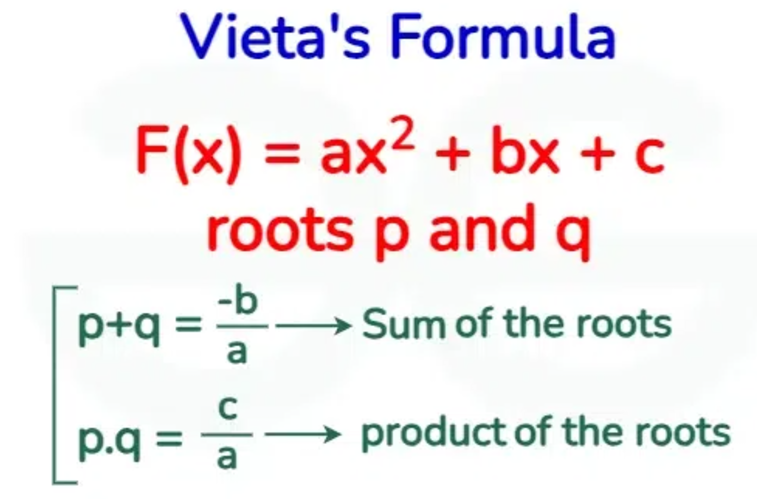
Vieta’s Formulas
Refer to the image above. Remember, don’t get the sum and the product of roots values mixed up!! If you are unsure use an equation to test, like x^2 + 5x + 6. Fun fact: These formulas were invented by François Viète, a French mathematician. He worked on questions for up to three days straight […]
Minimum distance from a point to a line
The minimum distance from a point to a line can be thought of as a line. What I mean by that is, if we draw a line named $Bobbi$ and he must have the shortest possible height, then lil Bobbi’s feet must be perpendicular to the line. You could, of course, calculate this by noticing […]

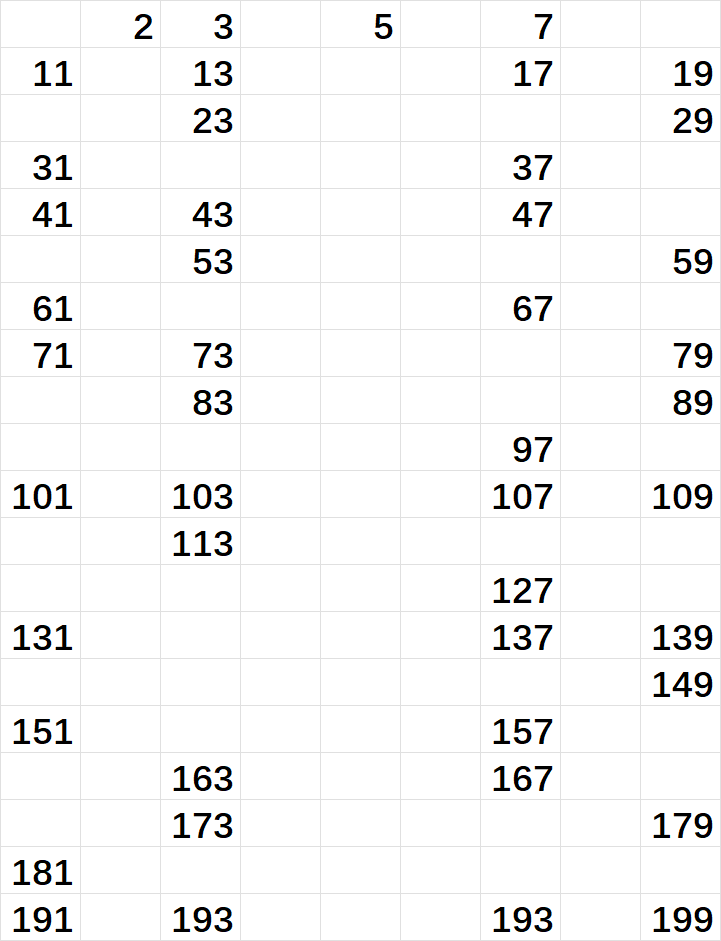
The Sieve of Eratosthenes
That is a sieve. I usually use sieves to sift my cake flour. Sifting cake flour means the bulky stuff is forced through these small holes. Thus, the flour ends up fine; finer and softer than sand. Why must I sift my cake flour? So the finished cake is light as a feather and soft […]
Important Cube Exponent Equations
If $a^2=4$, then $a=\pm 2$ ALWAYS READ THE QUESTION FOR EXAMPLE: Remember to bring a ruler and an eraser and a brand-new mechanical PENCIL!!! pls don’t forget the RULER
Telescoping
A telescoping sum is a sum that is calculated when immediate terms cancel out. For terms like $\frac{1}{n(n + k)}$, it equals $\frac{1}{k}(\frac{1}{n} – \frac{1}{n + 1})$. A special case, 1, must be noted. Everything simplifies to $\frac{1}{n} – \frac{1}{n – 1}$ There are also other telescoping formulas, like General Linear Denominator and Radical Telescoping […]
This is LaTeX
There will be more coming tomorrow so stay watchful!
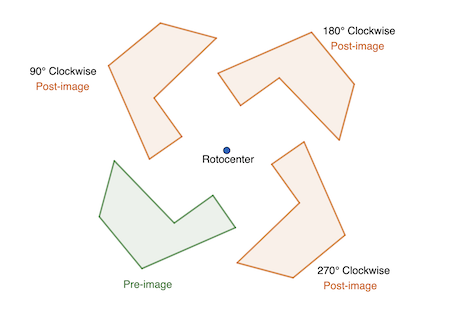
Distance Preserving Proprety of Rotation
Rotation is a transformation in metric spaces. Though the positions of points and lines will change, their lengths and angles will not. A rotation is a type of isometry that moves all points according to a fixed point known as the rotocenter.